New Millennium War Plans (#120)

Nine stories, 16 links. New from me: The Trump regime is the latest this millennium to fail to create reality; how I learned about the Strait of Hormuz in 1984; Iran was not close to having a nuclear bomb; Iran tries to destroy petrodollar exclusivity; the Orbánization of the US media; Polymarket gamblers threaten reporter; an example of a media outlet laundering White House talking points; thanking the inventor of the gas tank arrow; and the Cybertruck is more explosive than the Pinto.
Here we go. I’m glad you’re here.
“It might be helpful for you to know that you are not alone. And that in the long, twilight struggle which lies ahead of us, there is the possibility of hope.” “The Long Twilight Struggle.” Babylon 5, created and written by J. Michael Straczynski, Season 2, Episode 20, 1995.
#1
- You Can Just Do Things (Patrick Blanchfield, N+1, Link to Article)
- Faith, Certainty and the Presidency of George W. Bush (Ron Suskind, New York Times Magazine, Link to Article)
It is clear that the Trump regime did not have a plan for what would happen after the initial bombing of Iran on February 28, 2026.
While our military servicemembers achieved overwhelming successes, U.S. political leaders have once again failed to have a strategic plan ready for what happens next.
We have experienced this failure by listening to Trump regime officials sharing so many different—and sometimes conflicting—justifications for the war (one of the stories I found interesting in newsletter #119).
After our troops hit their initial targets, what was victory? Did we want a regime change? What did we expect to happen in the Strait of Hormuz? Why was the Trump regime surprised Iran would attack other Gulf states? For how long could we keep up a battle against low-cost drone attacks? Would there be any need to stabilize energy and fertilizer prices?
While the Trump regime’s failures are remarkable, they are not unprecedented. Leaders of both political parties have fallen into this trap this millennium. And, as Patrick Blanchfield explains, returning to an incident at the beginning of the 21st century sets the stage for what we are experiencing today.
In the summer of 2002, the United States put together a military exercise with a name that broadcast the nation’s ambitions for projecting force not just into a New American Century, but beyond. Years in the planning, and costing around $250 million ($435 million today), the “Millennium Challenge” was the single most expensive simulation the military had ever mounted. Mustering some 13,500 American servicepersons across military branches and theaters for three weeks of intricate joint-service operations, the enterprise sought to put the latest in military doctrine, hardware, and communications infrastructure to the test. With the war in Afghanistan in full swing and the invasion of Iraq on the near horizon, the wargame also offered George W. Bush and his cabinet a nonpareil opportunity to rehearse their much-coveted fantasy of taking the global war on terror to the next target on the Axis of Evil: Iran. The primary antagonists were cast accordingly: Team Blue would be the US, and Team Red would be a Persian Gulf power whose resources and disposition of forces approximated an amalgam of Iran and Iraq. Blue and Red were set into conflict per an elaborate background scenario involving disputed island territories, threats to regional shipping, sectarian fundamentalists, naval showdowns, high-priority land-based targets, and the like. To head Red’s forces, the United States Joint Forces Command (USJFCOM) tapped a retired Marine Corps Brigadier General with a bullet-headed central casting mien, a chest bedecked with decades of combat decorations, and the Pynchonesque name of Paul K. Van Riper.
Sailing into the theater, Blue demanded the immediate surrender of Red. Van Riper, however, declined to serve up his comparatively backward forces to his enemy’s cutting-edge reconnaissance and surveillance technology. Instead, the veteran counterinsurgency fighter went analog, running communications to units via motorcycles and dispatching his vintage Soviet and American-made planes on sorties using light and flag signals instead of radio. And then, using local fishing boats as cheap patrol craft, he launched a sneak attack on the US fleet, swarming them with inexpensive missiles and ramming them with suicide runs.
The effect was catastrophic. On the first day of the exercise, in just ten minutes, Riper’s Reds “sank” sixteen American warships, including an aircraft carrier, ten cruisers, and all but one of Blue’s amphibious landing vessels. Had the wargame been real, the cost in hardware would have been billions; by USJFCOM’s own reckoning, twenty thousand Americans would have come home in boxes, or, to put it more bluntly, been vaporized, drowned, or eaten by sharks. A subordinate broke the news to General William “Buck” Kernan, one of the Millennium Challenge’s designers: “Sir, Van Riper just slimed the ships.”
What to do? Having lost its game of Battleship against a developing world adversary that never had any battleships to begin with, US military brass immediately called foul and demanded a do-over. After all, there were thousands of assets already in the field, and still plenty of time to “learn.”
When the Millennium Challenge’s organizers rebooted the exercise, they placed a suite of new restrictions on Red. Troops had to use radios, even if doing so guaranteed their prompt annihilation. Van Riper was forbidden from using his abundant chemical weapon stockpiles. His forces were no longer allowed to open fire on American transport aircraft, meaning that Blue’s venerable C-130s, and its brand-new $84 million V-22 Ospreys, could fly in unthreatened by anything except mechanical malfunctions.(1) Most importantly, it was decreed from the outset that no matter what happened, Blue would win.
Oh, how convenient! Instead of learning lessons from an innovative and realistic strategy, the organizers changed the rules of the game to ensure that our expensive military machines and tactics would win.
That was in keeping with the Bush-Cheney Administration’s post-9/11 worldview. Journalist Ron Suskind spoke with an anonymous senior advisor in the Bush administration (whom we later learned was likely Karl Rove) a few weeks before this exercise. Rove was trying to educate Suskind about how he (wrongly) believed the world now worked. As Suskind writes:
The aide said that guys like me were "in what we call the reality-based community," which he defined as people who "believe that solutions emerge from your judicious study of discernible reality." I nodded and murmured something about enlightenment principles and empiricism. He cut me off. "That's not the way the world really works anymore," he continued. "We're an empire now, and when we act, we create our own reality. And while you're studying that reality – judiciously, as you will – we'll act again, creating other new realities, which you can study too, and that's how things will sort out. We're history's actors . . . and you, all of you, will be left to just study what we do."
The hubris. That is just not how the world works. Rove, his bosses, and our nation would eventually experience this lesson the hard way in Iraq and Afghanistan.
But, as Blanchfield further explains in his piece, so much of our military and foreign policy this millennium has been based on the premise that our military is so strong and powerful that we don’t have to learn lessons. We can bend the world to our rules. We can always hit the reset button.
Former President Biden’s decision to withdraw from Afghanistan (a process initiated based on a deal made by a first-term President Trump) is one of the exceptions to this rule. For this, though, Biden was excoriated by pundits and the political elite. Biden never regained the popularity he held beforehand. The resulting political weakness left him without the goodwill he would have needed to politically survive a catastrophic debate performance.
But even in that withdrawal, we were caught by surprise that our billions in training and treasure did not buy enough time to keep the Taliban at bay long enough to allow for an organized retreat.
Trump, as is his wont, has taken these trends to their extreme. We have been told that Trump will decide the Iran War is over when he “feel[s] it in his bones.”
But General Jim Mattis, who served as Secretary of Defense during Trump’s first term, often taught, “No war is over until the enemy says it’s over. We may think it over, but in fact, the enemy gets a vote.”
It is clear that the Trump regime was not—and is not— ready to handle that fact. Whether it is Iran’s regime selecting a Supreme Leader that Trump declared unacceptable, drones hitting targets in the region, or the shutdown of the Strait of Hormuz, Iran gets a vote. They need to make things as painful as possible for the United States to demonstrate what the price is for attacking them.
As Blanchfield sums up this moment:
But events don’t end when we say they do. We do not enjoy a singular and uncontested prerogative to alter reality through magical thinking, force of arms, indignant entitlement, and sheer dippy fiat. We may think we’re playing a game that ends when we say it does, that the past only matters when we want it to, that the places we project our power will somehow always remain elsewhere, that the repressed will never return, and that repression takes no toll on all parties involved. At some point, and on some timeline you don’t get to choose, the world pushes back. You can just do things, sure, right until the game is up, and then you can’t.
#2
- Countdown to Looking Glass [Television Show] (Wikipedia, Link to Article)
- Trump Brain Trust Figured Iran Wouldn’t Block the Strait of Hormuz. Oh Well … (Josh Marshall, Talking Points Memo, Link to Article)
- Why Trump Didn’t Plan for the Strait of Hormuz (Phillips Payson O’Brien, The Atlantic, Link to Article)
- The Implications of Iran Mining the Strait of Hormuz Are Many—and Ugly (Brynn Tannehill, The New Republic, Link to Article)
In October 1984, this then-13-year-old sat down to watch a new made-for-television movie on HBO: Countdown to Looking Glass.
As a news junkie and military brat experiencing some of the coldest parts of the Cold War, this new program had so much going for it. It opens with this voiceover:
"The program you are about to see is based on a war game, developed with the help of military experts and advisors. Its purpose is to inform, not to alarm. You will witness a series of events reported by the evening news on television, a series of events that could lead us to the brink of World War III. At this moment, flying over the United States is a military airborne command plane. It is a communication outpost for the President and Strategic Air Command. It is capable of transmitting orders to US forces across the world during a nuclear confrontation. Its code name is 'Looking Glass'."
Over the nine days covered in the program, a South American financial crisis leads to unrest among the Gulf states. A Soviet-backed coup in Oman causes King Faud of Saudi Arabia to request United States help. The Soviet Union sees the U.S.’s decision to provide significant military assistance to Saudi Arabia as a hostile action. In response, the Soviet Union’s allies in Oman impose a large financial toll on every oil tanker seeking to transit the Strait of Hormuz.
Yep. That one.
The situation deteriorates from there into the exchange of tactical nuclear weapons among the ships in the Gulf area. The White House is evacuated, and the Emergency Broadcast System is activated.
Anyway, since then, I have known the Strait of Hormuz could be a dangerous place, one that gives the countries surrounding it significant power.
In our timeline, though, it is Iran—not Oman—who closes down the Strait in response to U.S. actions.
Almost all of the war scenarios I’ve read about the Persian Gulf include a blockade of the Strait of Hormuz as a likely escalation. It is a key example of asymmetric warfare, where Iran can cause major problems for superior militaries like that of the United States. It should not be a surprise.
And yet, as The Atlantic’s Phillips Payson O’Brien writes:
Astonishingly, President Trump and his aides were caught unprepared when Iran, under air assault from the United States and Israel, retaliated by targeting shipping in the Persian Gulf region and specifically through the Strait of Hormuz. Military planners have pointed out for decades that the waterway—through which one-fifth of the world’s oil and liquefied natural gas passes—is highly vulnerable to Iranian assault. But the Trump administration acknowledged in classified briefings, CNN reported last night, that it did not make provisions for a closure because officials assumed that such a move would hurt Iran more than the United States.
In its failure to anticipate Iran’s reaction, the administration ignored a dynamic that former Defense Secretary James Mattis, a first-term Trump appointee, was fond of pointing out: Once hostilities begin, “the enemy gets a vote.” U.S. leaders have drastically underestimated the Iranian regime’s ability to survive, adjust, and strike back. Just two weeks into a war that began at a time of the president’s choosing, the U.S. appears uncertain about what to do next.
Did the Trump regime really not understand that Iran’s leaders would prioritize the survival of its regime over economic pain? Iran wins as long as it maintains continuity of government. They don’t have to play by our assumptions, no matter what Trump feels in his bones.
As Talking Points Memo’s Josh Marshall explains:
It’s hard to overstate this level of stupidity, incompetence and arrogance. You don’t need to be a foreign relations or region expert to know about this. If you’re even a medium-saturation news consumer you’ve seen maybe a hundred CNN panels on just this subject over the last 30 years. It’s one of the central planning scenarios for the U.S. military. And war games and training scenarios virtually always focus on Iran, or a made-up country meant to stand in for Iran, as the culprit for the simple reason that the U.S. been the guarantor of free navigation in the Gulf since the early 1970s and Iran has been its top regional adversary since 1979.
The idea that Iran wouldn’t have the nerve to impede trade through the Gulf or that it would hurt Iran more than the U.S. is not only contradicted by decades of military planning. It conflicts with the White House’s own stated goals. When you define the goal of your war as overthrowing the adversary government itself, all things become possible, all threats become real. The threat of a short- or medium-term cutoff in oil exports is by definition not an unthinkable threat to a government whose very existence is gravely imperiled by foreign attack. It’s a very big threat to the United States since the U.S. currently faces no real threat to its territory or population or even its military forces in the region.
In The New Republic, Brynn Tannehill explains how closing and mining the Strait of Hormuz can create long-term problems that continue even after the potential resolution of this war. We also don’t have the effective mine-sweeping assets in the area after the Trump regime’s decision to remove four dedicated minesweepers last September, when planning for this war was apparently underway.
Mines are effective, and they are a big problem even for warships designed to withstand hits. Of the 19 U.S. vessels sunk or disabled since World War II, 15 were damaged by mines. These include the Aegis cruiser USS Princeton and the Iwo Jima–class amphibious assault ship USS Tripoli on the same day during the Persian Gulf War. A World War I–era contact mine nearly sank the 4,500 ton guided missile frigate USS Samuel B. Roberts on April 14, 1988, which survived only due to exceptional damage-control efforts by her crew.
Once mines are in the water, they’re very difficult to find, even with modern gear. The process of finding them is slow and painstaking, leaving the ships and aircraft conducting the search as sitting ducks in the middle of a hot war. It also requires multiple sweeps of the same area to ensure that all mines have been neutralized.
…
As much as some defense experts are crowing about the damage being done to Iran’s capabilities, it is my assessment that Iran believes it will win this conflict via economic strangulation. America’s adversaries know that the way to win a war against it is to drag the conflict out and wait for public opinion to turn against it. Nothing turns the public against the incumbent party like a tanked economy and a disastrous war. The Iranians believe they’ll achieve favorable terms once the U.S. economy begins to crater and the public turns against Trump for starting a war he couldn’t finish.
Donald Trump has been able to rely on some outside force to protect him and clean up his messes since his father made him a millionaire by the age of eight, thanks to tax avoidance schemes.
But after attacking our allies and imposing random tariffs on the world since taking office, there are few countries willing to come to his aid—especially after Trump refused to consult with countries ahead of time. Here’s a quick scorecard:
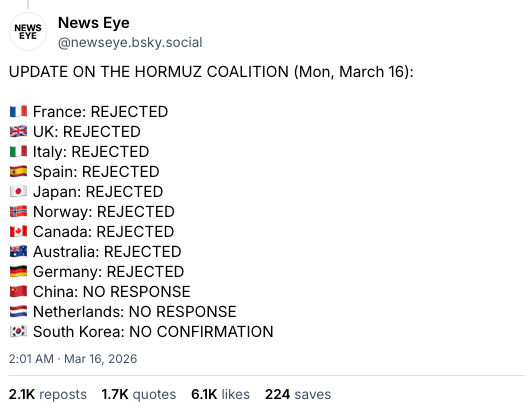
Wow. The president was right. I really can’t handle all of this “winning.” I wish he would stop.
Anyway, I really liked Countdown to Looking Glass. I end up rewatching it every couple of years. It’s on YouTube if you’d like to go down yet another Cold War memory lane that’s hitting just a bit too close to home today.
#3
- Iran was nowhere close to a nuclear bomb, experts say (Dan Vergano, Scientific American, Link to Article)
Supporters of the Trump regime’s decision to join the Iran War point to claims made by the president that Iran was just two to four weeks away from having a nuclear weapon.
But a lie remains a lie, no matter how often it’s repeated.
“There was no evidence that Iran was close to a nuclear weapon,” says Jeffrey Lewis of the James Martin Center for Nonproliferation Studies at the Middlebury Institute of International Studies. His comment echoed those of other experts after the war’s start, as well as statements from International Atomic Energy Agency (IAEA) chief Rafael Grossi at that time and in 2025 and last year’s “threat assessment” report by U.S. intelligence agencies.
According to an IAEA estimate, as of June 2025, Iran possessed 441 kilograms of 60 percent enriched uranium, where the percentage refers to the share of the isotope uranium 235 (U 235) found in the material. That would be enough for 10 nuclear weapons if the material could be enriched further to full 90 percent weapons-grade concentrations, according to the IAEA. That further enrichment would take a matter of weeks in a fully functioning Iranian nuclear complex, perhaps explaining the time line within Trump’s declaration.
That step alone doesn’t equal a bomb, however. And Iran’s main enrichment capabilities were “completely and totally obliterated,” according to Trump himself in June, after the U.S. bombed three underground Iranian facilities. The administration’s special envoy to the Middle East Steve Witkoff nonetheless claimed on March 3, after the start of the current war, that Iran had the capability to make 11 nuclear bombs. Trump administration officials reportedly failed to include nuclear technical experts in their negotiation teams with Iran prior to the war, adding to the uncertainty. If Iran really had rebuilt these facilities, that might have led—over months and not weeks—to the nation resuming its uranium enrichment, Lewis says. “But this is all ‘if,’ ‘maybe’ and ‘later,’” he adds.
Perhaps it would have been useful for Witkoff and Jared Kushner to have had nuclear experts available to consult with while they were pretending to negotiate a political solution before the bombs started falling. Statements they have made since the war began indicate that they did not understand the scientific details or potentially significant concessions Iran was offering.
Timelines matter. If we totally obliterated the Iranian’s nuclear enrichment capabilities in June, then the 441 kilograms of 60 percent uranium could not be made into 10-11 bombs in two to four weeks time.
Did Trump, Witkoff, or Kushner care? Or were the two negotiators just the cover for a military operation? I hope a future Congress makes it a priority to find out.
#4
- Why Iran’s Most Dangerous Weapon in This War Isn’t a Missile. It’s the Yuan (European Business Magazine, Link to Article)
Iran is considering allowing a limited number of oil tankers to pass through the Strait of Hormuz on the condition that the cargo is traded in Chinese yuan, a senior Iranian official told CNN. Yenisafak The official described the potential move as part of Tehran’s plan to manage the controlled reopening of the strategic waterway, which has been effectively closed since March 1 following US-Israeli attacks on Iran. Yenisafak
The financial implications deserve more attention than they have so far received.
To understand why the yuan condition matters, it is necessary to understand what the petrodollar system actually is. Born from the Nixon shock of 1971 and formalised in 1974, the arrangement under which Saudi Arabia and the broader Gulf agreed to denominate all oil sales in US dollars created a self-reinforcing loop that has governed global finance ever since. Because oil — the world’s most traded commodity — must be purchased in dollars, every nation that imports energy must first acquire dollars. Every central bank holds dollar reserves for precisely this reason. The dollar’s status as the world’s primary reserve currency is not an abstract achievement; it flows directly and mechanically from oil.
Global oil is predominantly traded in US dollars, except for sanctioned Russian oil, which is priced in roubles or yuan. Yenisafak Iran’s proposal would extend that exception to the world’s single most critical maritime chokepoint.
Here is yet another example of the soft power advantages Donald Trump has weakened or destroyed so far in his second term.
Our allies no longer trust us. He has weakened NATO. He allowed Elon Musk and DOGE to send USAID to the wood chipper.
Destroying the petrodollar system should not be underestimated. The fact that the dollar is used worldwide has given our economy advantages that only a fool would toss away.
It will be nearly impossible to recreate these advantages going forward. Why is Trump so determined to throw them away? Why have Congressional Republicans enabled him? If opposing China is so vital to MAGA, why are so few America Firsters objecting as Trump empowers Beijing through his policies?
#5
- Trump Threatens Broadcasters Over Iran War Coverage, A Move Straight Out of Russia (Olga Lautman, Unmasking Russia, Link to Article)
- Raging at Media, Pete Hegseth Just Said the Quiet Part Out Loud (Greg Sargent, The New Republic, Link to Article)
- The Orbanisation of American media is here (Chris Herrmann, European Council on Foreign Relations, Link to Article)
- The Patriotic Press (Parker Malloy, Link to Article)
The failures of Secretary of Defense Pete Hegseth are among the reasons we have a chance to turn back the Trump regime’s authoritarian capture attempt.
It’s not just his bullying leadership style. He also exhibits the same lack of care and restraint during his public statements as he does when conducting classified business via electronic messages. Like other members of the Trump axis, he keeps saying the quiet parts out loud. As Greg Sargent writes:
Pete Hegseth wants to live in a world in which the American military can drop bombs on scores of schoolchildren and not face serious media scrutiny over it. And he just might get that world soon enough.
That’s the only way to understand the defense secretary’s extraordinary outburst on Friday morning. He lashed out at news organizations, criticizing headlines that aren’t sufficiently laudatory of American military successes in the Iran war.
“I know that everything is written intentionally,” Hegseth said of the media, referring to his own previous stint as a Fox News contributor, thus seemingly admitting that Fox, at least, does deliberately skew coverage. He faulted numerous headlines, insisting that rather than report things like “Mideast War Intensifies,” the press should instead be “patriotic” and write headlines like: “Iran Increasingly Desperate.”
The visibly angry Hegseth also ridiculed a CNN story reporting that Trump’s war planners “underestimated the Iran war’s impact on the Strait of Hormuz.” He added: “The sooner David Ellison takes over that network, the better.”
That’s a direct reference to Paramount CEO David Ellison, who is acquiring CNN after taking over and creating a more Trump-friendly CBS. In short, Hegseth openly relishes future oligarchical control of the media to ensure more dutiful amplification of his propaganda.
Everyone who is watching that merger play out understands that Trump pushed for Paramount to win the bidding war over Warner Bros. Discovery because he expects David Ellison to kneecap CNN like he did to CBS News.
It just isn’t something one expects a saavy government official to say on camera and on the record. But then again, it’s Hegseth.
Trump is following a control-the-press playbook created by Russia’s Vladmir Putin and Hungary’s Victor Orbán. As Unmasking Russia’s Olga Lautman explains:
When the Kremlin launched its full-scale invasion of Ukraine in February 2022, one of its first moves was to seize control of the information environment surrounding the war. Russian authorities banned journalists from describing the genocidal invasion as a “war,” forcing media outlets to use the phrase “special military operation,” while simultaneously passing laws threatening reporters with up to fifteen years in prison for publishing information that contradicted the government’s narrative. The handful of remaining independent outlets that had survived years of Kremlin pressure were shut down, blocked, or forced into exile, cementing Russia’s media landscape as a tightly controlled propaganda machine portraying the invasion as a “righteous” campaign against “Nazis” and “Western aggression.”
Trump has not yet reached the stage of jailing journalists for reporting inconvenient facts about his operations and wars, but is clearly moving in that direction.
The instinct driving these attacks is unmistakably familiar: the belief that reporting should reinforce the government’s narrative rather than challenge it, and that journalists who expose uncomfortable truths are somehow undermining the country rather than doing the job democracy requires of them. This logic sits at the core of authoritarian rule, where information is not meant to inform the public but to shape perception, suppress dissent, and protect those in power from scrutiny.
Orbán has followed a similar path since he returned to office following an election that created an electoral autocracy. As the European Council on Foreign Relations’ Chris Herrman explains:
Hungarian prime minister Viktor Orban and his Fidesz government have meticulously used legal manoeuvres to subjugate unfriendly outlets and defang independent media. While the Media Council enforces vague standards of “balanced” or “moral” reporting, Fidesz politicians denounce critical journalists as foreign agents or traitors. A prime example is the radio station Klubradio, which lost its licence in 2021 on procedural pretexts after years of being branded “hostile”.
Under President Donald Trump, American media is being “Orbanised” in a similar way—not through bans or formal censorship, but through presidential power exercised via signals, leverage and regulatory alignment. The goal is to deliver a clear message: troublemaking is costly, compliance is safe.
The government doesn’t have to punish media outlets or reporters if everyone understands that they can comply in advance. That’s why CBS under Bari Weiss now reworks 60 Minutes stories. That’s why FCC Chair Brendan Carr keeps issuing threats that go beyond the statutory powers of his office.
Be nice to Trump. Otherwise, things could get complicated.
And during a time of war, the situation becomes even more complex. The stakes rise as the regime puts U.S. soldiers in harm’s way. Our nation’s history provides examples of how far a government will go to ensure positive coverage of military situations.
Hegseth was angry at a CNN story that demonstrated how the Trump regime—and Hegseth—failed to plan for the obvious consequences of going to war with Iran. Parker Malloy goes into detail about what Hegseth believes a patriotic press would do instead:
Go back to the CNN story that set Hegseth off. Read what it actually says.
It says that Trump’s national security team, by relying on a tight inner circle instead of the normal interagency process, failed to seriously plan for Iran closing the Strait of Hormuz in response to U.S. strikes. It says energy executives have been telling the administration they want the war over and won’t risk their tankers until the fighting slows down. The Navy told those same executives it wasn’t safe enough to escort ships through the strait. Trump’s own Energy Secretary, Chris Wright, said on CNN that escorts weren’t ready yet. At today’s briefing, neither Hegseth nor Joint Chiefs Chairman Gen. Dan Caine disputed that.
Trump’s response to all of this was to tell tanker crews to “show some guts.” Iran’s new supreme leader, meanwhile, declared the strait would stay closed as a “tool of pressure.”
That’s the story Hegseth called “fundamentally unserious.” The reporting he wants Ellison to make go away. Not opinion. Not speculation. Sourced reporting about whether the government adequately planned for a predictable consequence of its own war.
The facts don’t change just because they anger Donald Trump or Pete Hegseth. We need to support media outlets willing to fight back, and demand Democratic elected officials use whatever leverage they have to ensure the truth still matters.
#6
- Gamblers trying to win a bet on Polymarket are vowing to kill me if I don’t rewrite an Iran missile story (Emanuel Fabian, Times of Israel, Link to Article)
On Tuesday, March 10, a massive explosion shook the city of Beit Shemesh, just outside Jerusalem, in yet another Iranian ballistic missile attack during the ongoing war.
Rescue services scrambled to the scene in search of possible casualties, though as it turned out, the projectile had struck a forested area just outside the city, around 500 meters from homes.
On The Times of Israel’s liveblog that day, I reported that the missile had hit an open area and no injuries were caused, citing the rescue services, as well as footage that emerged showing the massive explosion caused by the missile’s warhead.
But what I thought was a seemingly minor incident during the war has turned into days of harassment and death threats against me.
Why? Because this report would be crucial to determining which side of a Polymarket bet would win a wager about whether Israel would be hit by an Iranian missile on March 10.
My minor report on a missile striking an open area was now in the middle of a betting war, with those who had bet “No” on an Iranian strike on Israel on March 10 demanding I change my article to ensure they would win big.
In the article, Fabian explains how he figured out what was happening to him. He relays a series of threats, including death threats, aimed at him for refusing to change his story. Some gamblers tried to have Fabian’s journalist colleagues contact him about changing his report.
These prediction/gambling markets are the latest example of tech companies finding loopholes in the law to create markets to exploit. They have led to betting scandals in professional and college sports. There was even, for a time, a betting market about the chances of a nuclear exchange.
A deregulation decision from the Trump regime opened the door for these prediction markets to open in states where sports betting is not legal. The negative ramifications will be a major story in our culture over the next few years.
#7
- The Trump administration just laundered its bogus energy affordability talking points through Politico’s White House team (Justin Gerdes, Quitting Carbon Media, Link to Article)
Given an “exclusive” by the White House, Politico returned the favor by giving the administration the gift of its perfect, preferred headline.
“Inside the White House obsession with reducing energy prices,” reads a story published [in January].
“Obsession” is Politico’s choice of word. No Trump administration official is quoted using the word in the story.
So, what is the basis for the declaration that the White House is newly laser-focused on energy affordability?
“The White House has zeroed in on energy prices as a political and economic pressure point heading into this year’s midterms, ordering an all-of-government accounting of how the administration can make electricity cheaper for American households,” write Sophia Cai and Cheyenne Haslett.
“In early December, officials across the government were asked to assemble a comprehensive briefing on the administration’s actions on energy affordability – a sign that lowering electricity and fuel costs has become a top priority for President Donald Trump with control of the House on the line as midterm elections approach,” they add.
Had Politico assigned the story to its laudable E&E News team, the energy policy reporters there would have challenged the administration’s spin. Instead, we are delivered White House talking points from two political reporters – Cai is a White House reporter and co-author of West Wing Playbook and Haslett recently joined Politico’s White House team to help lead its health care and technology policy coverage.
The White House press office does have some professionals who know how to get this kind of coverage by offering an exclusive. It happens often. Politicians do it. Corporations do it.
There is no reason for media outlets to play along, though. This dynamic has always been annoying, but it is particularly glaring given that the Trump regime continues to call the media “fake news” and “the enemy.”
The editors should know better, especially when they have experts on the payroll whom they can consult.
It is a good idea for readers to take a look at the details when they see laudatory coverage from a national or international outlet. If it is an exclusive, are any of the media outlet’s subject matter experts involved?
If not, dig a bit deeper to see if there is more to the story. There are many independent outlets that can provide context.
#8
- RIP The Guy Who Put The Little Arrow On Your Fuel Gauge Though I Think There Was An Earlier One (Jason Torchinsky, The Autopian, Link to Article)
If there’s one car fact or Easter Egg or detail (or whatever you want to call it) that seems to delight non-car-obsessed people more than any other one, I think it has to be this one: fuel gauges tend to have a little arrow on them that points to what side the fuel filler is on.
People absolutely love this little detail, and they’re right to do so! It’s really a design triumph, a tiny bit of extra graphics on a dashboard that makes life quantifiably better. And it was the idea of one man, a man named Jim Moylan, and I’m sad to inform you that Mr. Moylan passed away on December 11, at the age of 80.
This little arrow has spared me frustration on more than one occasion. I enjoyed reading about the frustrating time in the rain that led Moylan to propose the arrow to his bosses at Ford.
#9
- It’s Official: the Cybertruck is More Explosive than the Ford Pinto (Kay Leadfoot, Fuel Arc, Link to Article)
TL;DR: The CyberTruck is 17 times more likely to have a fire fatality than a Ford Pinto.
…
So, in conclusion, the Cybertruck is far more dangerous (by volume) that the historic poster child for corporate greed and grossly antagonistic design.
I look forward to the Cybertruck being governmentally crash-tested by the NHTSA, which it has not been thus far. Until then, I can’t recommend sitting in one.
While this is not Elon Musk’s deadliest decision (that would be the millions he will kill by destroying USAID), we need to have a conversation about how this guy has been able to ship so many defective cars without the government at least conducting the tests so consumers can make informed decisions.
Follow me on BlueSky to see the stories I’m finding and the tabs I’m opening in real-time.

On January 6, 2021, Donald Trump instigated a violent insurrection against the United States government. Here’s a video from the Select Committee to Investigate the January 6th Attack on the United States Capitol that one can review if their memory fades.
People were hurt and police officers died protecting the Capitol. Vice President Pence and other elected officials just barely escaped danger. Our national streak of peaceful transfers of power ended.
It was not, as Trump claims, a “day of love.” And we must resist his efforts to rewrite the history of that dark day.
The Long Twilight Struggle is free and supported voluntarily by its readers. If you liked what you read and can afford it, please consider becoming a paid subscriber! Or, if you prefer, feel free to buy me a coffee using the tip jar.